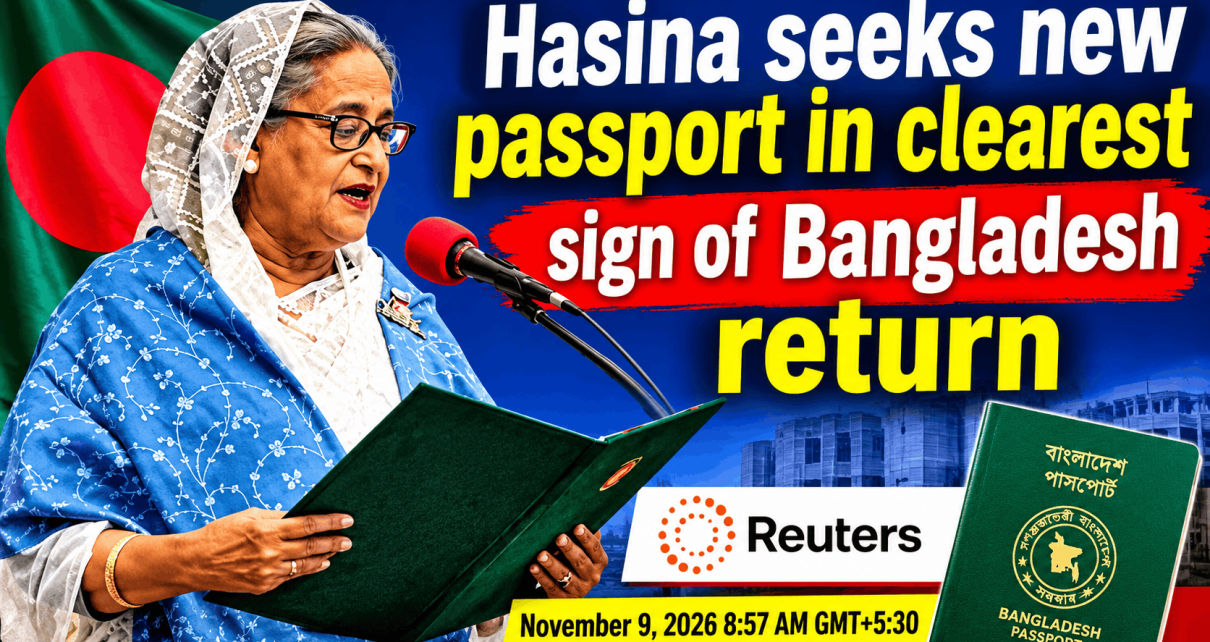
On 5 November 2026, Bangladesh’s State Minister for Foreign Affairs, Humaiun Kabir, announced that former Prime Minister Sheikh Hasina, currently living in exile in India, would not be issued a regular passport or a travel pass to return to the country. Kabir stated that she must be brought back to Bangladesh from Delhi under the existing extradition treaty between Bangladesh and India.[1]
Thereafter, Sheikh Hasina applied for a fresh passport. “In view of the reported revocation of her existing Bangladeshi passport and National Identity Card (NID) by the Interim Government and other authorities, I respectfully request that you take the necessary steps to issue a new Bangladeshi passport and National Identity Card for our client,” Hasina’s lawyers at London-based Matrix Chambers wrote to Preeti Rahman, acting high commissioner at Bangladesh’s embassy in Delhi. The letter asked for the applications to be processed “expeditiously” on the basis of her Bangladeshi nationality and in accordance with “obligations arising under international human rights instruments”.[2]
I. Bangladesh violating Sheikh Hasina’s right to return guaranteed under the Constitution of Bangladesh and ICCPR
The right to return is a fundamental human right recognised under international human rights law, international humanitarian law and international refugee law as well the Constitution of Bangladesh. It protects the rights of every person to return to their own country, including their place of origin or habitual residence, without arbitrary restrictions.
Article 13(2) of the Universal Declaration of Human Rights (UDHR) recognises the right to return. It states “Everyone has the right to leave any country, including his own, and to return to his country”.[3]
Further, the right to return under Article 13(2) of the UDHR was made legally binding to the ratifying State parties of International Covenant on Civil and Political Rights (ICCPR) under Article 14(2), which states that “No one shall be arbitrarily deprived of the right to enter his own country”.[4] Bangladesh has ratified the ICCPR [5]and therefore, is legally bound to ensure Sheikh Hasina’s return.
In fact, the right to return is recognised under Article 36 of the Constitution of Bangladesh and it provides that “Subject to any reasonable restrictions imposed by law in the public interest, every citizen shall have the right to move freely throughout Bangladesh, to reside and settle in any place therein and to leave and re-enter Bangladesh”.[6]
Furthermore, a Bangladesh citizen like Sheikh Hasina enjoys the right to equal protection of the law even while living in exile as per Article 31 of the Constitution of Bangladesh. Article 31 of the Constitution of Bangladesh provides that “To enjoy the protection of the law, and to be treated in accordance with law, and only in accordance with law, is the inalienable right of every citizen, wherever he may be, and of every other person for the time being within Bangladesh, and in particular no action detrimental to the life, liberty, body, reputation or property of any person shall be taken except in accordance with law”.[7]
This right has been elaborated further by the Supreme Court of Bangladesh. The Appellate Division of the Supreme Court of Bangladesh in its judgment dated 27 September 2021 in Durnity Daman Commission Versus G.B. Hossai and Others held that “Article 36 of the Constitution permits imposition of restrictions. However, such restrictions must be by way of the law enacted and must be reasonably needed in the public interest” and “Without backing of law imposition of restriction on the freedom of movement by an executive order will be unconstitutional”.[8]
There is no law in Bangladesh prohibiting the entry of its citizens. Therefore, the declaration of Bangladesh’s State Minister for Foreign Affairs, Humaiun Kabir or any other executive order denying Sheikh Hasina the right to return to Bangladesh shall be illegal and further constitutes a violation of her fundamental right.
II. Unlawful excuse of not issuing passport or travelling document to Sheikh Hasina to deny her fundamental right
Former Prime Minister Sheikh Hasina was ousted on 5 August 2024 and she arrived in India in a C-130 Bangladesh Air Force transport aircraft arranged by the Bangladesh government.[9] Since 23 December 2024, then Interim Government of Bangladesh led by Dr Muhammad Yunus[10] and thereafter, the current Bangladesh National Party government led by Tarique Rahman demanded extradition Sheikh Hasina from India.[11] Successive governments of Bangladesh blamed India for not extraditing her.
However, after Hasina announced her decision to return to Bangladesh despite being given death sentence by International Criminal Court in November 2025[12], a local Bangladeshi court in absentia for alleged crimes against humanity, Bangladesh has been making excuses to prevent her return!
The statement of Bangladesh’s State Minister for Foreign Affairs, Humaiun Kabir that Hasina would not be issued a regular passport or a travel pass to return to the country and she must be brought back to Bangladesh from Delhi under the existing extradition treaty between Bangladesh and India is without any legal basis and is only meant to deny her right to return.
The Indo-Bangladesh Extradition Treaty[13] contains no provision that allows to deny a passport or travel document to any person subjected to request for extradition. Rather Article 20 of the Indo-Bangladesh Extradition Treaty provides that “the present Treaty shall not affect the rights and obligations of the Contracting States arising from International Conventions and Treaties to which they are parties”. Both India and Bangladesh have ratified the ICCPR and are legally bound to respect Article 14(2) of the ICCPR which guarantees the right of every person not to be arbitrarily deprived of the right to enter their own country. While applying the Indo-Bangladesh Extradition Treaty, both countries are required to ensure respect for the the right to return under Article 36 of the Constitution of Bangladesh and Article 14(2) of the ICCPR.
In fact, it is a standard universal practice for the home country to issue either a passport or a travel document for any person wishing to return to the country or to be repatriated to any country. No responsible home country accepts / allows anyone to enter the country first without verifying the nationality.
Bangladesh should, therefore, facilitate the issuance of a passport or an appropriate travel document to Sheikh Hasina to enable her return to the country voluntarily, without having to be brought back through extradition, if she wishes to face trial in connection with all the alleged cases filed against her.
III. The case for interventions to ensure the return of Sheikh Hasina
The denial of a passport to Sheikh Hasina to facilitate her return to her own country would constitute a serious violation of her fundamental rights.
The international community including the United Nations ought to intervene with the Government of Bangladesh to ensure that former Prime Minister Hasina is issued a passport or an appropriate travel document to facilitate her immediate return to the country.
(This paper is developed jointly with Asian Centre for Human Rights, New Delhi)
[1]. No travel pass for Hasina; extradition only: Humaiun, The Business Standard, 5 November 2026, https://www.tbsnews.net/bangladesh/hasina-must-be-handed-over-under-prisoner-extradition-treaty-not-issued-passport-humaiun
[2]. Hasina seeks new passport in clearest sign of Bangladesh return, Reuters, 9 November 2026, https://www.reuters.com/world/asia-pacific/hasina-seeks-new-passport-clearest-sign-bangladesh-return-2026-11-09/
[3]. The Universal Declaration of Human Rights can be accessed at https://www.un.org/en/about-us/universal-declaration-of-human-rights
[4]. The International Covenant on Civil and Political Rights can be accessed at https://www.ohchr.org/en/instruments-mechanisms/instruments/international-covenant-civil-and-political-rights
[5]. The status of ratification of the UN human rights treaties by Bangladesh including the ICCPR on 6 September 2000 can be accessed at https://tbinternet.ohchr.org/_layouts/15/TreatyBodyExternal/Treaty.aspx?CountryID=14&Lang=EN
[6]. Article 36 of the Constitution of Bangladesh can be accessed at https://bdlaws.minlaw.gov.bd/act-367/section-24584.html
[7]. Article 31 of the Constitution of Bangladesh can be accessed at https://bdlaws.minlaw.gov.bd/act-367/section-24579.html
[8]. The judgment of the Appellate Division of the Supreme Court of Bangladesh dated 27 September 2021 in Durnity Daman Commission Versus G.B. Hossai and Others can be accessed at https://www.supremecourt.gov.bd/resources/documents/1875134_C.P.Nos.605of2020,1009,1184,1340and1523of2021..pdf
[9]. SOS and ‘safe passage’ to India, Sheikh Hasina may stay in Delhi before leaving for London, The Telegraph, 6 August 2024, https://www.telegraphindia.com/india/sos-and-safe-passage-to-india-sheikh-hasina-may-stay-in-delhi-before-leaving-for-london/cid/2038902
[10]. Bangladesh seeks extradition of ousted leader Sheikh Hasina from India, Associated Press, 24 December 2024, https://apnews.com/article/bangladesh-sheikh-hasina-extradition-india-6effef70de22f18c502a7791360ece08
[11] . Bangladesh reiterates call for Hasina’s extradition during Delhi talks, The Hindu, 11 April 2026, https://www.thehindu.com/news/international/reiterated-demand-for-hasina-extradition-with-india-bangladesh-foreign-minister-rahman/article70850188.ece
[12]. Sheikh Hasina sentenced to death for crimes against humanity, The Daily Star, 17 November 2025, https://www.thedailystar.net/news/bangladesh/crime-justice/news/sheikh-hasina-sentenced-death-crimes-against-humanity-4036886
[13]. The Indo-Bangladesh Extradition Treaty can be accessed at https://www.mea.gov.in/Portal/LegalTreatiesDoc/BG13B1143.pdf