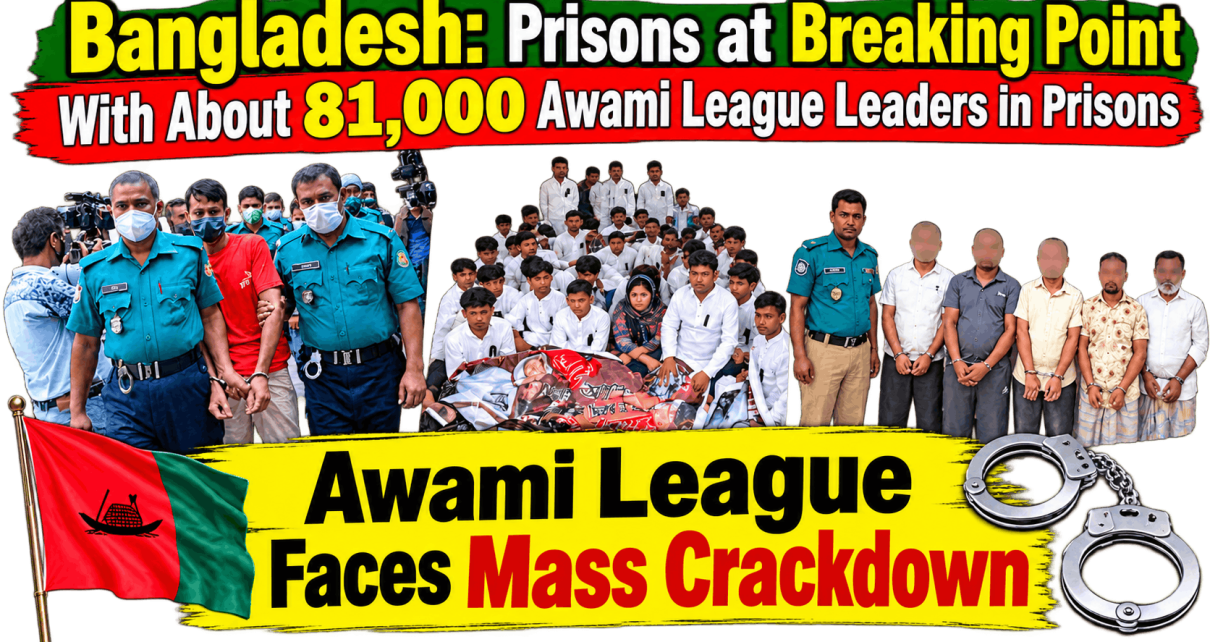
As workers of the oldest and largest political party in Bangladesh, the Awami League, and its affiliate organisations fight back for political survival and inclusive politics after the party was banned under the Anti-Terrorism Act on 12 May 2024, Bangladesh’s prisons are on the verge of reaching breaking point with overcrowding. The government, led by the Bangladesh Nationalist Party (BNP), continues to imprison Awami League workers by branding them as alleged terrorists. Instead of reversing the blunder committed by the interim government of Dr Muhammad Yunus in banning an entire political party rather than holding individuals under the previous Awami League government accountable for their actions, the BNP continues to treat the party that brought independence to Bangladesh as a terrorist organisation. This amounts to an outright misuse of anti-terrorism legislation.
The Awami League, which is estimated to command the support of around 40% of the population, appears buoyed by former Prime Minister Sheikh Hasina’s announcement that she intends to return to the country in December 2026 to face the trial for the alleged offences. Since October 2026, the Awami League has sought to resume its political activities and the BNP government has responded with thousands of arrests. Consequently, political activities are increasingly turning violent.
Bangladesh is increasingly heading towards a possible civil war as the government seeks to prevent the return of former Prime Minister Hasina and cling to power through the BNP-Jamaat alliance.
Bangladesh could soon pose a serious threat to regional peace and security unless the international community acts to promote inclusive politics and address the blatant abuse of anti-terrorism legislation.
A. Over 81,000 Awami League workers languishing in prison as prisoners allegedly forced to sleep in toilets because of overcrowding
According to the data of the Department of Prisons of the Government of Bangladesh, as on 14 October 2026, the total number of inmates stood at 130,128 with more than 75,000 awaiting trial against sanctioned capacity of 45,186 inmates in 75 prisons.[1]
These figures from the Department of Prisons appear to be contrary to statements of the Dhaka Metropolitan Police which stated that 195,146 persons, averaging around 1,650 persons per day were arrested between 1 May and 26 August 2026 and around 5,005 people between 1 and 11 October 2026.[2] In mid-November 2026, Rumin Farhana, an independent Member of Parliament, based on the testimonies of released inmates alleged that prisoners were sleeping in toilets because of overcrowding.[3]
There have been reports of continuing arrest of Awami League workers. Between 1 and 14 November 2026, at least 2,813 leaders, activists and supporters of the Awami League and its affiliate organisations were reportedly arrested.[4] On 17 November 2026, the Dhaka Metropolitan Police claimed to have arrested 526 people in 24 hours, including 50 members of the Awami League and its banned student wing, the Bangladesh Chhatra League. This followed the arrest of 480 people across the capital during the preceding 24 hours, on 16 November 2026, which also included Awami League and Chhatra League activists.[5]
When the Awami League government led by former Prime Minister Sheikh Hasina fell on 5 August 2024, there were about 88,000 inmates in all prisons across the country as of 4 August 2024. The prison population under former Prime Minister Hasina had reached 88,000 due to the mass arrests during July 2024. However, the number of prisoners dropped to 49,000 inmates on 12 August 2024 following the fall of the government and the release of many political prisoners.[6]
Prison population statistics had earlier indicated a declining trend. The World Prison Brief (WPB), an online database maintained by the Institute for Crime and Justice Policy Research at Birkbeck College, University of London, reported prison populations of 88,084 inmates in 2020; 83,107 inmates in 2021, and 82,766 inmates in 2022 and 77,203 inmates in 2023.[7]
Considering that the prison population had been declining from 2020 onward, and assuming that the number of prisoners charged with ordinary crimes stood at 49,000 on 12 August 2024, it can be assumed that at least 81,000 members of the Awami League and its affiliate organisations have been are languishing in prison to take the prison population to 130,128 on 14 October 2026.
Indeed, the statistics of the total number of inmates stood at 130,128 as on 14 October 2026 appear to be conservation. In mid-November 2026, Rumin Farhana, an independent Member of Parliament, based on the testimonies of released inmates alleged that prisoners were sleeping in toilets because of overcrowding.[3]
B. Torturous prison conditions
Bangladesh has sanctioned capacity of 45,186 inmates in 75 prisons. As of 14 October 2026, the total prison inmates were 130,128, representing an occupancy rate of approximately 288%, or 188% above the authorised capacity.[8]
Undoubtedly, prison conditions remain torturous. However, the absence of doctors makes the situation even more alarming.
Against the sanctioned posts of 151 doctors for 75 prisons, there are only 10 regular doctors. The entire prison system also has just 23 ambulances, meaning that most prisons do not have ambulances of their own. The shortages become particularly critical when a prisoner develops chest pain, breathing difficulties, stroke symptoms or another medical emergency requiring specialised treatment outside prison.[9]
This has resulted in a large number of custodial deaths in prisons. According to the Department of Prisons, 97 prisoners died in the first two months of 2026 alone, including 55 in January and 42 in February. In 2025, of the 270 deaths among prison inmates, 155 were attributed to natural causes, while 111 inmates died while being transported to hospitals and four died from unnatural causes. In 2024, of the 261 deaths in prison custody, approximately 140 were attributed to natural causes, while 120 inmates died on their way to hospitals and one death was classified as unnatural. In 2023, of the 290 deaths in prison custody, 187 were attributed to natural causes, approximately 101 inmates died on their way to hospitals, and two deaths were classified as unnatural.[10]
Article 35(5) of the Constitution of Bangladesh relating to prohibition of torture states, that “No person shall be subjected to torture or cruel, inhuman or degrading punishment or treatment”. The Constitution further guarantees the protection of the law under Article 31, the right to life and personal liberty under Article 32, safeguards against arrest and detention under Article 33, and the right to a speedy and public trial under Article 35(3). These guarantees have been systematically violated.[11]
Bangladesh is also a State Party to the International Covenant on Civil and Political Rights (ICCPR) and the UN Convention Against Torture (UNCAT), and the provisions of these international instruments are being violated.[12]
C. Lift the ban on the Awami League immediately and ensure return of former Prime Minister Hasina
On 12 May 2025, the Anti-Terrorism (Amendment) Ordinance 2025 was promulgated to allow an entity to be temporarily suspended and to prohibit all activities (physical, digital or expressive) by a person or entity “against whom action has been taken” under the Act, without having to proscribe or formally list it as an entity involved in terrorist activities, as required under the pre-existing Anti-Terrorism Act 2009. The amended Section 20 also introduced an explicit prohibition on “any publicity”, including press statements, social media content or public gatherings in support of such persons or entities. Restrictions can further be imposed on travel outside the country, and income and expenditure must be disclosed. On 12 May 2025, the Government of Bangladesh also formally banned all Awami League activities “until the completion of proceedings before the International Crimes Tribunal” against Sheikh Hasina and other party leaders, citing national security and the protection of plaintiffs and witnesses”.[13]
Bangladesh’s Anti-Terrorism Act has effectively become an instrument for preventive detention of the Awami League workers. Section 32 of the Act imposes stringent conditions for bail, including a mandatory opportunity for the public prosecutor to oppose bail and a requirement that the court be satisfied, and record in writing, that there are reasonable grounds to believe that the accused may not be found guilty at trial, etc.[14] This has become the means for denial of the bail to the Awami League workers.
In a communication, the mandates of the UN Special Rapporteur on the promotion and protection of human rights and fundamental freedoms while countering terrorism, the Working Group on Arbitrary Detention, and the Special Rapporteur on the independence of judges and lawyers stated that:
“The suspension of the Awami League under the Anti-Terrorism (Amendment) Ordinance 2025 may further fail to meet the international law requirement that a restriction on association be properly authorised by law, since the new procedure circumvents the established legislative powers under the Anti-Terrorism Act 2009 and does not conform with international standards for prohibiting organisations under counter-terrorism law. To list an organization as terrorist under international law, it must have the substantial purpose of engaging in genuinely terrorist offences as properly defined, to a high standard of proof, in addition to providing due process and judicial safeguards. The restrictions flowing from suspension may also not strictly be necessary and proportionate in the case of the Awami League. We emphasize that the use of counter-terrorism powers to suppress a political party, rather than to address specific, individualized, and credible threats of violence, risks undermining the very democratic order that such laws are intended to protect”.[15]
In view of the opinion of the UN Special Rapporteurs, the ban on the Awami League ought to be lifted immediately, to prevent the country from descending into civil war. As the third preambular paragraph of the Universal Declaration of Human Rights states, “Whereas it is essential, if man is not to be compelled to have recourse, as a last resort, to rebellion against tyranny and oppression, that human rights should be protected by the rule of law”.[16] If the Awami League is effectively sought to be extinguished by maintaining the ban on it as a terrorist organisation, the Bangladesh Government will face rebellion and, eventually, a civil war.
It is essential that inclusive politics is allowed in the country and former Prime Minister Sheikh Hasina is allowed to return to the country with guarantees for safety and security of life and liberties, and the right to fair trial as guaranteed under the Constitution of Bangladesh and the ICCPR ratified by the Bangladesh Government on 6 September 2000.
[1]. More than 1,000 arrested daily as Bangladesh prisons exceed capacity, Dhaka Tribune,17 October 2026, https://www.dhakatribune.com/bangladesh/crime/422283/more-than-1-000-arrested-daily-as-bangladesh
[2]. More than 1,000 arrested daily as Bangladesh prisons exceed capacity, Dhaka Tribune,17 October 2026, https://www.dhakatribune.com/bangladesh/crime/422283/more-than-1-000-arrested-daily-as-bangladesh
[3]. The statement of Rumin Farhana can be accessed at https://www.youtube.com/shorts/VHehDYsbW6U
[4]. Post of Bangladesh Watch, 20 November 2026, https://x.com/bdwatch2024/status/2123656250609242396
[5]. 50 Awami League, Chhatra League members among 526 arrested in Dhaka, BDNews24, 17 November 2026, https://bdnews24.com/bangladesh/o39pvr2037
[6]. Over 77,000 inmates as prisons capacity exceed by 180pc, Prothom Alo, 4 August 2024, https://en.prothomalo.com/bangladesh/gad5odrdth?
[7]. Crammed jails – Not anymore, Dhaka Tribune, 08 January 2025, https://www.dhakatribune.com/amp/bangladesh/370231/crammed-jails-%E2%80%93-not-anymore
[8]. More than 1,000 arrested daily as Bangladesh prisons exceed capacity, Dhaka Tribune,17 October 2026, https://www.dhakatribune.com/bangladesh/crime/422283/more-than-1-000-arrested-daily-as-bangladesh
[9]. 100,000 prisoners, 10 doctors, 23 ambulances, Dhaka Tribune, 11 September 2026, https://www.dhakatribune.com/bangladesh/dhaka/419567/100-000-prisoners-10-doctors-23-ambulances%C2%A0
[10]. Inmate fatalities rise amid doctor, ambulance shortages, Dhaka Tribune, 28 March 2026, https://www.dhakatribune.com/amp/bangladesh/406323/inmate-fatalities-rise-amid-doctor-ambulance
[11]. The Constitution of Bangladesh can be accessed at https://bdlaws.minlaw.gov.bd/act-367/part-details-200.html
[12]. The status of ratification of various treaties by Bangladesh can be accessed at https://tbinternet.ohchr.org/_layouts/15/TreatyBodyExternal/Treaty.aspx?CountryID=14&Lang=EN
[13]. Communication of the Mandates of the Special Rapporteur on the promotion and protection of human rights and fundamental freedoms while countering terrorism; the Working Group on Arbitrary Detention and the Special Rapporteur on the independence of judges and lawyers , Ref.: AL BGD 6/2025, 29 December 2025, https://spcommreports.ohchr.org/TMResultsBase/DownLoadPublicCommunicationFile?gId=30514&
[14]. The Anti-Terrorism Act, 2009 can be accessed at https://objectstorage.ap-dcc-gazipur-1.oraclecloud15.com/n/axvjbnqprylg/b/V2Ministry/o/office-legislativediv/2024/12/512090bb4c56466fb0af149d07d88612.pdf
[15]. Communication of the Mandates of the Special Rapporteur on the promotion and protection of human rights and fundamental freedoms while countering terrorism; the Working Group on Arbitrary Detention and the Special Rapporteur on the independence of judges and lawyers , Ref.: AL BGD 6/2025, 29 December 2025, https://spcommreports.ohchr.org/TMResultsBase/DownLoadPublicCommunicationFile?gId=30514&
[16]. The Universal Declaration of Human Rights can be accessed at https://www.ohchr.org/en/human-rights/universal-declaration/translations/english